Gaining Momentum

It has been a productive week for me – artistically. I have been working hard on my latest project, which is a Pirates of the Caribbean theme, and I really like where it is going. Because this is another gift for someone, I will have to hold off on showing you some progression photos, but I will have those up when the painting is complete. I am also in the process of creating another short movie about creating this painting.

I have spent the last year or two educating myself on the various techniques of still-life and figurative painting. When I finally went back to a landscape painting last year (The Runoff), I was disappointed in the results. I felt that my landscape skills had stalled and I realized I needed to balance my skills better to accommodate the various aspects of my current projects. For example, my current project is a mixture of figurative, landscape, and portraiture work. If two of the elements appear strong, they will still be overwhelmed by a weak third element. As nice a face I might paint, if the tree is a formless blob then the viewers eyes will just focus on that. So I have been working hard on my landscape skills and I hope it shows in this next project.
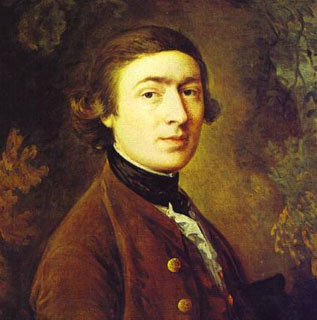
Thomas Gainsborough
Thomas Gainsborough

I guess I figured I had achieved a sense of accomplishment with landscape works or perhaps I just got a little bored with landscapes – or both. I entered the oil painting realm with the desire to paint landscapes, but then I realized that there was so much more I could cover that I got lost in my explorations. I can now say that figurative works are my favorite. I love depicting people in scenes that tell stories, however I still have a great love for landscapes. It’s funny that my feelings on these genres are completely opposite of my favorite oil painter – Thomas Gainsborough.

Gainsborough (1727-1788), was from England and was a tremendous portrait and figure artist. Even if you think you have never heard his name, you are most likely familiar with his most famous work The Blue Boy. Not only could he convincingly render emotions in his faces, but he could bring out the fine details of the clothing his subjects were wearing. In the Blue Boy for example, I don’t think it’s the youthful skin tones he rendered, but the blue satin on the boy that makes this a classic. Light seems to pour off the canvas from his costume even without the bright gallery lighting. I’ve been fortunate enough to see this painting in person (it sits in San Marino at the Huntington Library) and I was in awe of it. The eyes of the boy seem to penetrate his viewers and leave you pondering why he appears so confident. The boy gives off such confidence that you might suspect he has just won something. The background is so understated that you don’t even notice it. It’s a very serene landscape with earth tones to complement the cool blue satin of the costume. The funny thing here is that Gainsborough actually didn’t like doing portraits. He only painted them out of financial necessity. Commissions for portraits came in constantly which gave him a comfortable living. In his early years however, he was trying to sell his real passion – landscapes. They didn’t sell well though, not because people thought they were substandard, but because oil portraits were the rage in those times. So he continued the portraits to make his living and it wasn’t until his later years, after he made his mark on portraiture, that he returned to his first love.
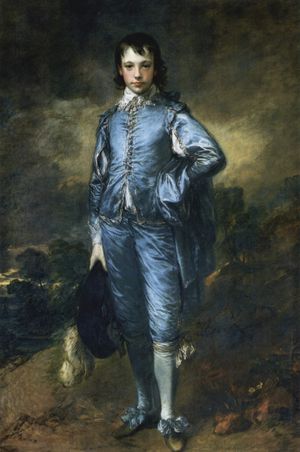
The Blue Boy by Thomas Gainsborough

While my first love was landscapes, it has since shifted to rendering people. Since I don’t have to rely on my art sales exclusively; I don’t have to target my works at a particular audience. I certainly appreciate the various genres of oil painting as they have their own inherit challenges. In my mind, a good artist can specialize in one genre, but since many paintings include faces, still objects, animals, and landscape elements (sometimes all of these in one), it is important to be competent in all of these areas. That is my goal now and that is why I am working on my landscape skills.

See you next post.
Prepare for Pirates!

Sometimes the hardest part about solving a problem is getting started. Where does this problem come from? Perhaps we see the problem and only think about the multitude of hurdles that could impede us as we work to completion. Perhaps we worry that we’ll invest laborious hours and heavy emotion into a project only to find us left wanting in the end. Or perhaps we are simply trying to put the horse before the cart – we have no attack plan. I’ve experienced all of these problems in painting and in other aspects of my life. I’ve learned through my failures that a good plan is required to solve any complex problem. No architect lays concrete or erects beams of steel before drafting a blue print. The same principles apply to the artist. For any subject with multiple characters or objects, we must conceive of the compositional sketch before we touch the canvas.

The Luncheon on the Grass c. 1865 - Claude Monet
The Luncheon on the Grass c. 1865 - Claude Monet. This shows the level of detail Monet put into his sketches so he knew what he wanted when he hit the canvas.

When I started painting in oils back in 2005, I never really sketched out my ideas. I simply had a vague idea about a scene I wanted to render and I went about doing it on canvas. In my mind, I was never going to make a mistake and my imagination was going to transfer to the canvas perfectly. Then I learned that what you expect to happen often doesn’t. I made many mistakes as I painted – both in form and composition. The results were paintings that disappointed me so much that I have them laying in a dark closet to only see the light of day when I need a harsh reminder about the dangers of impatience. Six years later, I sketch my ideas for days if not weeks before I even look at the canvas.

I think the best choice I’ve ever made in my little art career is carrying a sketch book. This book keeps everything from 60 second doodles to full pencil renderings of projects I want to pursue. Thanks to my wife, I now have two avenues with which to create my preliminary sketches. I was gifted a digital pen and pad so that I can now render simple sketches or full color digital paintings on the computer. Nothing can replace the pencil and paper, but this digital pen can do some great things. For example, I can draw a quick sketch, select a few colors for the sketch, and then move around the elements just to get a rough idea on what might work in the painting. I can also simulate oil painting in my sketches by clicking the mouse and changing from pencil mark to brush stroke. I admit that this system does take some getting used to. I’ve been training my eye to not look at my hand and focus instead on the screen. I’m practicing almost everyday so I’m making progress. I’ve completed some sketches of multiple projects that I plan on completing this year and I want to share with you the project I’m working on now.

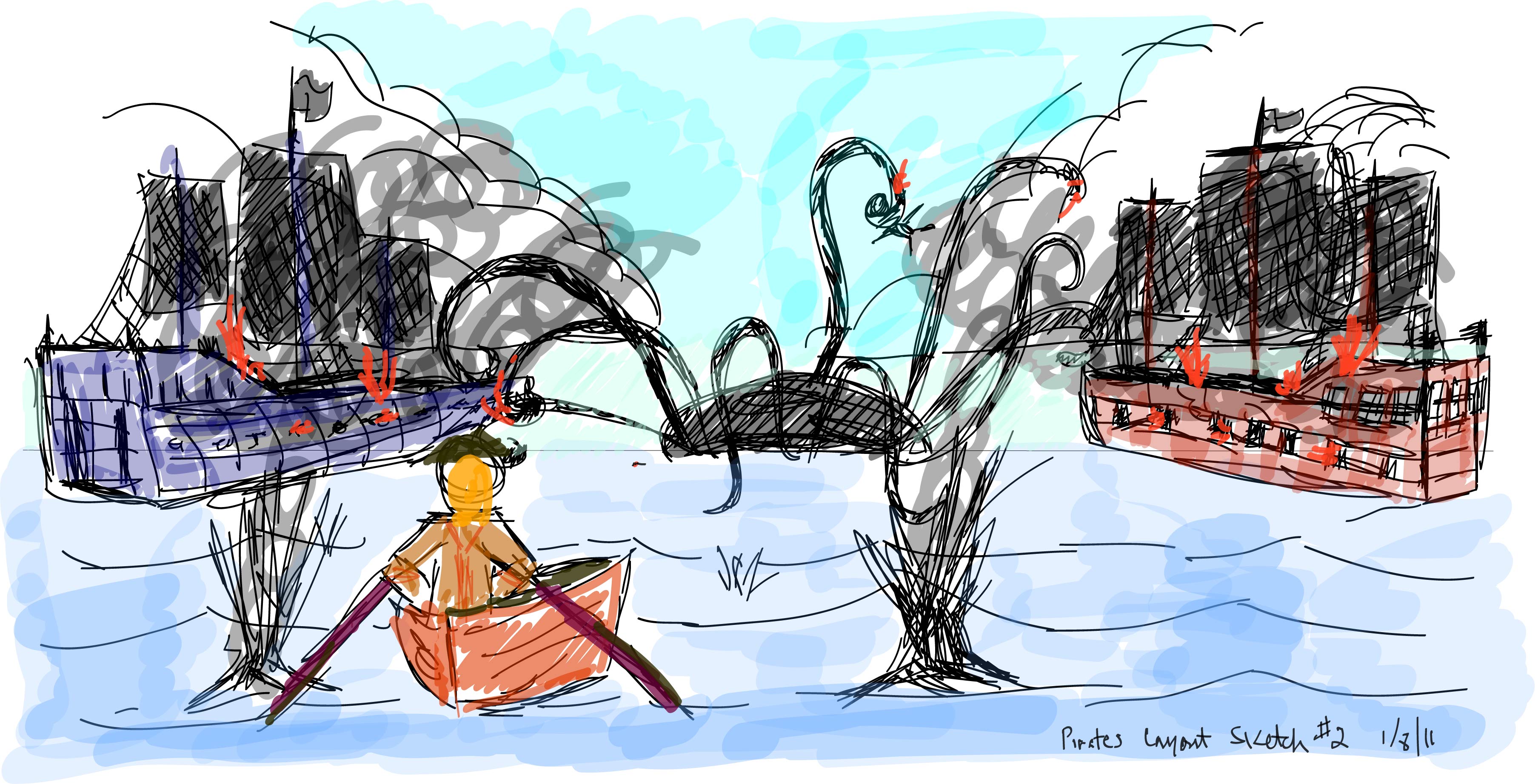
Composition Sketch for upcoming Pirate painting.
Pirates Compositional Sketch - This was done with the Bamboo Pen & Touch program and adobe illustrator.

Based on the Pirates of the Caribbean films, this painting will depict pirate ships, a sea monster, and some familiar characters. With all of these elements in mind, I simply couldn’t jump on the canvas and try to sort it out as I went – the results would be a mess. So I’ve been sketching on paper and on the computer. You notice in this sketch that it’s a compositional sketch only. This means there are no details, no faces, no waves, no boards, and no puffs of clouds. This sketch is only to get the layout of the main elements – pirate, ships, and the monster. I then plunked in a few basic colors to get a quick idea of the color scheme. I’ve since settled more or less on this layout and so I printed this out as a reference for the duration of the work. The sketch is to scale so I can place markers on the actual canvas of where the subjects will be. I love this pen and pad. The product is the Bamboo Pen & Touch if you are interested in purchasing it. It only retails for about $100 so it is certainly affordable. You can expect to see more of these digital sketches on my blog and my website. Remember that preparation is crucial to the problem-solving process. This applies to every aspect of life and not just art – think before you leap and sketch before you paint.

In other news, I’ve just created a YouTube account and will start posting small videos of my painting projects for everyone to see. Anything on this channel will also reside on my website. I’ll have more information on this in the near future.

In my next posting, I’ll be talking about one of my favorite artists. Stay tuned and subscribe! Thanks!

It’s a Mad-Happy New Year!

Happy New Year to everyone! I hope everyone had an enjoyable holiday season. I certainly did as I was able to visit family and friends over the last 2 weeks. One of my favorite things about the holidays is reminiscing over old stories of the silly things you did when you were younger. I got a few laughs out this holiday season and I hope you did as well.

With all of the visiting I was doing, I took time away from the easel. With the year closing, I looked back at my goal from New Years 2010 and realized I did not even come close to my goal of completing 12 paintings during the year. I managed 6 paintings though and that is still better then in recent years when I was only completing 4 or 5. My favorite painting of 2010 is easily “An Early Memory.” I love that work so much because I spent many hours glazing the bear to get the soft fur look of the teddy bear. I also think the warm light helped to convey a sense of affection in the scene.

Mad to the Bone
Alice is relying on this mad cat for assistance? All ways are the Queen's ways! Copyright 2010 Ryan G. Williams

My 6th painting you have not seen until now. That’s because it was a Christmas gift for my Sister-in-law and I didn’t want her to see it before then. She loves the Cheshire cat from the “Alice in Wonderland” story and so I decided on a scene that focuses on the cat and his “mad” guidance. In the scene, Alice is wandering through Tulgey Wood and is about to breakdown in tears of frustration when the Cheshire cat appears and offers some suggestions. Unfortunately for Alice, there is no clear path home and she will have to encounter even more mad characters before she escapes. The signs tease her about this way and that way and even a path home, but she is utterly lost because ultimately, “all ways are the Queen’s ways.”

The color scheme was made to emulate the Disney version of the story as is the cat himself. I did embellish the size of the cat though to give it more prominence in the painting. I wanted to capture the soft light in the distance of the paths to create a strong spatial relationship between the forest and the figures. Alice has her back to us to remind us that the focus is the cat and not her. You will notice on the main tree where the cat sits is a carving. The carving reads: “CW + NT” which is a reference to my Sister-in-law’s and my Brother’s upcoming wedding this year (Congratulations guys!). The original is not available but this painting is available as a reproduction on canvas and paper.

As the New Year begins, I have hopes of completing more paintings this year than last. I set a goal of 12 last year. I realize this just won’t happen this year as I am planning a move in the summer. So my time is limited to work on new projects. Still, I am setting a lofty goal of 8 paintings to complete this year. What do my plans include? My top priority is to complete a Disneyland painting I started in 2005. I simply lost my confidence in the layout when I started and decided to put it on the shelf for a while. I think I can rectify the problems with it if I change my approach so I am going to give it another shot. Also in the works is another movie-inspired painting – this one will be from Pirates of the Caribbean. I will also be tackling another landscape or two, a still life, and perhaps a portrait of a loved one. For the rest of the works you will have to keep checking my blog.

I would like to thank those people who purchased works of my art in 2010 including Brian Lacey, Tracy Cook, and Bob Weston. I thank you for supporting my art and I hope my works bring you enjoyment throughout the years.

Have a great and inspired 2011!

alice in wonderland art

What Would You Pay for a Painting?

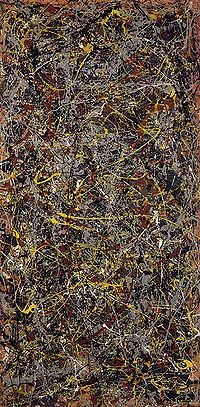
"No. 5" by Jackson Pollack - 1948
'No. 5' by Jackson Pollack is the highest selling painting to date. It sold for $140 million in 2006. Is this piece worth it? Depends on what the buyer is willing to pay.
I am in the design stages of a pirate themed painting – I will be posting the sketches soon. I also just completed a painting that won’t be displayed until after Christmas to avoid ruining the surprise for the receiver. In the meantime, I have been entertaining and educating myself on other artist’s ideas and opinions. Some discussions have been interesting to say the least.

For example, I recently was involved in a discussion in one of my art groups online about determining the value of a painting once you have completed it. This artist was clearly talented but he didn’t know how much to ask for when selling his work. Then he said something that made me jump into the discussion. He claimed that he saw artists who were asking thousands of dollars for their work and he felt those pieces were not hard to do and that because he could do a better job that his pieces should be worth even more. I rolled my eyes and began constructing my argument against his way of thinking.

So how do I value a painting? Well as I told this artist, the value is not based on level of difficulty – how would I even quantify that? I believe the value of a painting is determined by an assortment of factors including the medium, size, color, subject content, the amount of work involved, demand for the artist’s work, and others. There is simply no formula for artists to follow when assigning value to a painting. To illustrate my point to this person, I gave the example of two paintings of the same subject with different approaches. The subject is a coke can and the first is rendered in realism while the other is painted with an impressionist approach. I asked him that if the realist approach required more detail, does that mean it should be priced higher? There is no simple answer, but personally I would give the impressionist’s piece a higher price.

An Early Memory - Copyright Ryan Williams 2010
'An Early Memory' by Ryan Williams is selling for $550 framed. Is this a fair price? It all depends on what the artist feels the work is worth. For purchase information visit the gallery link.
The impressionist includes his own personal touch to this simple coke can while the realist is only painting everything that they see. If I wanted a painting of photographic quality then why not just take a photo of a coke can? I prefer to own art that contains a little bit of the artist’s soul in it. As for the price I would be willing to pay in this situation, well I would not pay much because the subject is so tame and uninteresting.With that said, when all is said and done, the artist has the right to throw out these considerations and slap an arbitrary price to their work. I prefer not to do such a thing. I price my pieces in a relatively affordable fashion because I feel that I need a reputation for successful work and a larger fan base before I can increase the value. In other words, the demand must be higher for me to raise the value. So there is no reason for me to slap thousands of dollars on my paintings when I know they will not sell for that price.

That is my point though – just because one painting is harder to execute does not make it worth more. I have seen many abstracts with a minimalist approach sell for thousands of dollars. This defies my logic because I don’t understand abstract to begin with, but in the art world nothing is logical and everything is spontaneous. This is the world I enjoy living in. You never know what you will see when you wake up each morning.

The Emotional Response of a Painting

It is amazing what a piece of art can do. Paintings are more then globs of pigment on canvas. They are windows into new worlds and ideas that lead our minds into new realms we never realized existed. A provocative subject can give us pause to think, a subject based in parody can spark a laugh, and for some of us, they can even provide healing powers. A young man who was in a hospital was able to cope with his disease by engaging in artistic projects. This happy story illustrates the powerful responses, both physical and emotional, a piece of art can garner.

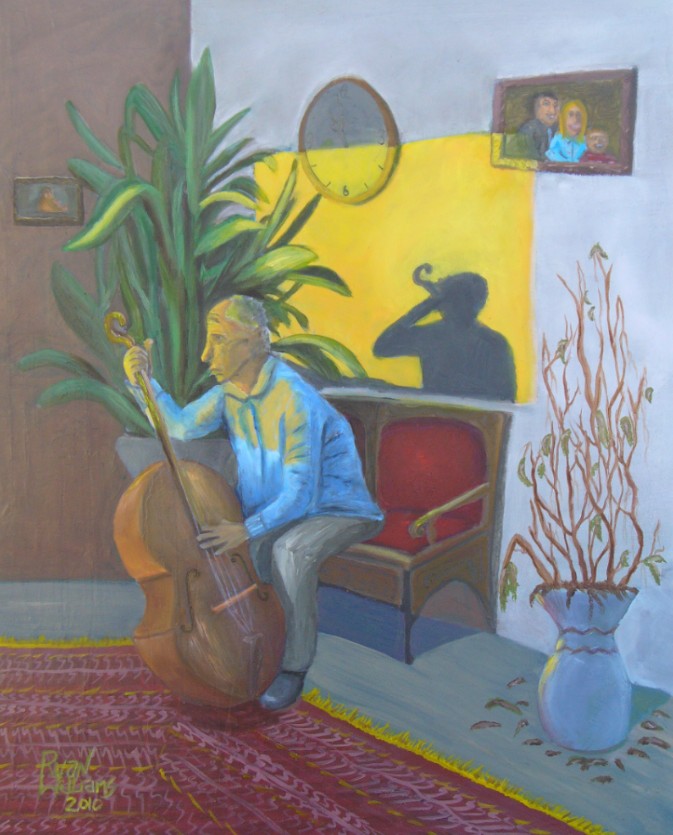
What kind of response do you get when you look at a painting? Any response is better than nothing for an artist’s goal is to have their work remembered. A painting can convey emotion just from the colors used or the composition chosen. Earlier this year I tried to convey a feeling of self-reflection and even a little regret in the work “It’s Never too Late.” The point of the work was to ask the question “Is it ever too late to try what you never tried?” In the scene, the old man is sitting on a chair while holding a cello. He has a pensive and urgent expression as he loses himself in a sunset that is fading away outside. He is pondering whether he could still try to learn this difficult instrument at his older age. Surrounded by family photographs, we assume he has made good choices for himself and found happiness. The expression suggests however that he does have some regrets. What has he sacrificed to obtain his happiness? What has he missed out on?

"It's Never Too Late" - Ryan G. Williams
It's Never Too Late - by Ryan G. Williams Copyright 2010 Original and prints available at ryanwilliamsart.com

To convey these feelings I used symbolism. The main theme here is the eternal force of time. The old man is a victim of time and the choices he is forced to make because of it. There are two plants surrounding him in this setting. One is full of life and touching the sunlight while the other is in shade and withering as it approaches its last days. Time has worked its power here and the old man is surrounded by it. The large clock on the wall hovers over the old man as a reminder that life is what happens while you are busy making other plans. The old man is in his own epicenter of action and consequence. While the family photographs are behind him and represent the choices made and his path chosen, he is looking ahead into a sun that is setting and realizing the life he has lived all of these years is also starting to set. He has limited time to resolve these remaining desires that he has put off in his old age. Will he try to learn this instrument like he always wanted to? Is it ever too late?

The next time you are stuck on a painting take a moment to determine why you have an interest in the work. Is it the subject, color, or something else? Artists appreciate knowing that their work is creating a response.